Closing the digital gap in agriculture: An interview with Mariya Hristova


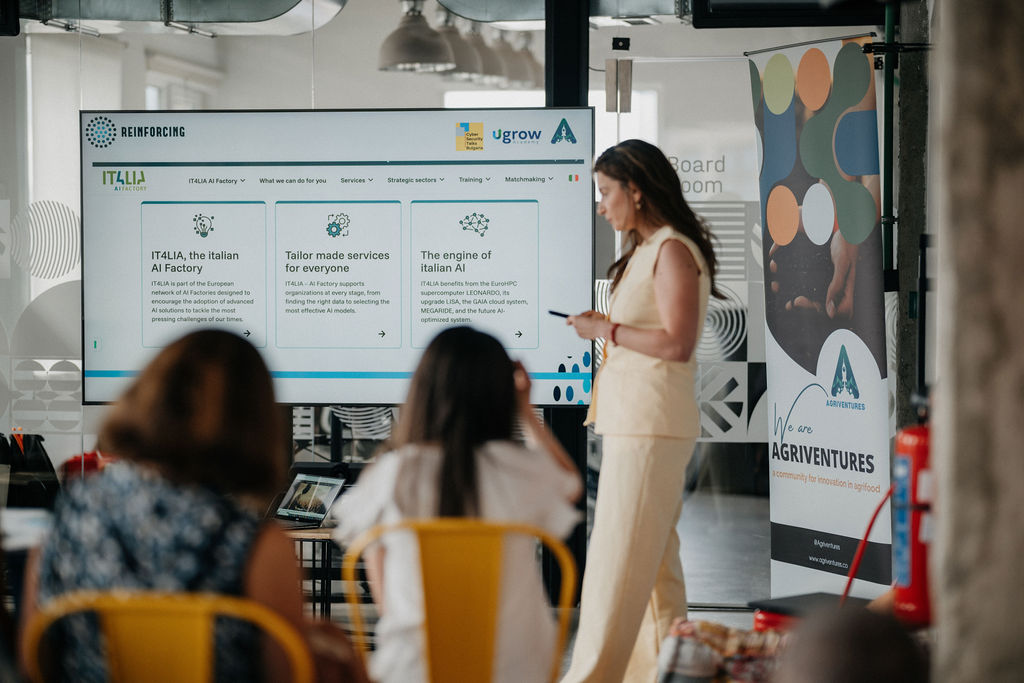
On July 6, SAFE AGRI brought together farmers, technologists, lawyers and cybersecurity experts in Bulgaria for a day dedicated to security and innovation in digital and hardware agri-food technologies. The event, organized by Agriventures under the REINFORCING project, moved through five parts: an introduction to Agriventures and the SAFE-AGRI initiative, a look at digital technologies and data in agriculture and food, the hidden vulnerabilities of digital agriculture, cybersecurity and the applicability of the NIS2 directive to the agri-food sector, and an interactive workshop session, closing with networking. Mariya Hristova of Agriventures presented "Digitalization and AI in Agriculture and Food," a data-driven look at where Bulgaria stands and where the EU is heading. We sat down with her to talk about the day, the numbers behind her talk, her colleagues' presentations, and what she's doing next.
Q: Let's start with your specialization. How did you end up focused on AI in agriculture?
A: Through Agriventures, I work at the intersection of European policy, market data and the actual farmers and food producers trying to make sense of it all. AI in agriculture isn't one story, it's dozens of stories: precision farming, food safety, traceability, robotics, regulation. My job is to pull the real numbers out of EU strategy documents, JRC surveys and market reports, and turn them into something a Bulgarian farmer or food processor can actually use to make a decision. That's also the thinking behind SAFE-AGRI itself, which is building an assessment framework, based on the Open and Responsible Research and Innovation approach, to help evaluate which emerging technologies, data systems or infrastructures in agriculture and food carry security relevance or strategic vulnerabilities. Right now that kind of methodical capacity barely exists, responsibility is scattered across agriculture, digital policy and security, and there's no strong forward-looking, inclusive process for assessing the risk.
Q: What did you present at SAFE AGRI?
A: I framed it around three questions: where does Bulgaria stand, where does the EU stand, and where is this all going. On the first question, the picture is sobering. Bulgaria is 28th, last in the EU, on the DESI digitalization index. Only 3% of Bulgarian enterprises use AI, compared to 8% across the EU, and just 6% use big data versus 14% EU-wide. In agriculture specifically, only 33,801 of the roughly 69,240 farms in the country had internet access by the end of 2025, and just 3,219 use any electronic system to manage their machinery fleet. We're starting from a low base, and I said that plainly.
I also spent time on skills, because digitalization isn't only a technology question. Only 8% of people in Bulgaria have digital skills above the basic level, against 26% on average across the EU. Agriculture accounted for 17% of total employment in Bulgaria in 2020, and CEDEFOP flags it as one of the sectors most exposed to job losses driven by an aging workforce running in parallel with automation. Closing the digital gap in Bulgarian agriculture is as much about training people as it is about installing sensors.
Q: And the EU picture?
A: More encouraging, but with its own pressures. There are 8.8 million farms across the EU, the average size has grown to 17.8 hectares from 11 hectares in 2005, which tells you this is consolidation, not expansion. 57.6% of EU farm managers were 55 or older in 2020, and only 11.9% were under 40. The farm workforce shrank 18% over the past decade. Automation isn't a nice-to-have there, it's a demographic necessity. The JRC's 2025 survey of 1,444 farms across nine member states found 93% already use at least one digital tool, 79% at least one crop-specific technology and 83% at least one livestock tool. Roughly three-quarters expect real economic, environmental and social benefits from going further. Bulgaria wasn't part of that survey sample, which is itself telling.
Q: You also covered AI in food processing specifically.
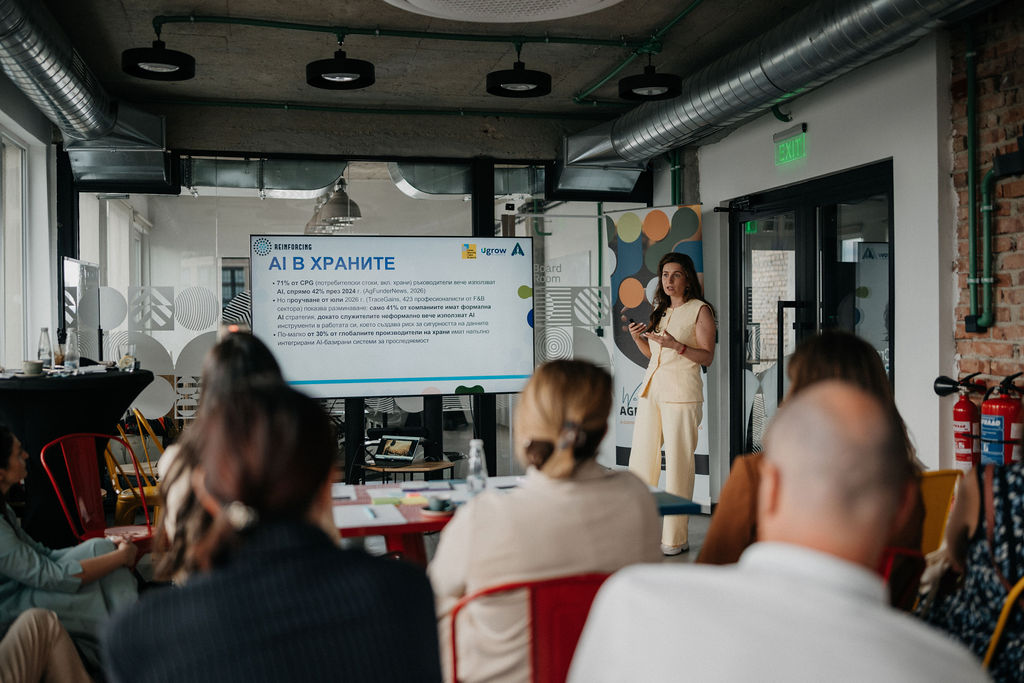
A: Yes, and that's where adoption is moving fastest. 71% of consumer goods executives now use AI, up from 42% just two years ago. But a July 2026 survey of 423 food and beverage professionals by TraceGains found only 41% of companies have a formal AI strategy, even though staff are already using AI tools informally in their day-to-day work, which creates real data security risk. Fewer than 30% of global food producers have fully integrated AI-based traceability systems. The market for AI in food safety and quality control alone is projected to grow from around $2.7 to 3.1 billion today to $13.7 billion by 2030, a compound annual growth rate of roughly 31%. Bulgaria's own national e-platform for food traceability, announced in June 2026, sits squarely in that category and is still being built.
Q: Any surprising numbers from the research?
A: The OECD-FAO projection stuck with people in the room: 73% of global crop production growth through 2035 will come from yield improvements, not new farmland. The technology to get there already exists, McKinsey's 2024 research found only 27% of European crop farmers use algorithms to monitor harvests and just 49% have precision irrigation controllers, roughly half the adoption rate seen in the US. The real question, especially for Bulgaria, is how fast we close the gap in skills, financing and access for small and mid-sized farms. If the roughly 1.47 billion lev earmarked in investment reaches them, the access gap can genuinely narrow by 2035. If it doesn't, the divide between large and small farms will only widen, and we're already seeing early signs of that in the 2026 data.
Q: Tell us about your colleagues' presentations. What did Dilyana cover?
A: Dilyana Kutsarova opened the day. She introduced Agriventures itself, our platform for funding opportunities across agri-food technology, carbon farming, digital and AI farming, circular economy, sustainability and bioeconomy, novel food and women in agrifood, and walked through what our team actually does: community building, capacity building, testing and screening support, an academy programme, and project support for sustainability assessments. She also introduced SAFE-AGRI in detail, its context, its goals and its three activities, an event on digital and hardware technologies in agriculture and processing, a second event on biotechnology and agricultural resources, and an ORRI-based assessment tool that consolidates the findings from both events around anticipation, inclusion, reflexivity and responsiveness. It set the frame for everything that followed. Dilyana also works with U Grow, and it's been genuinely energizing to develop ideas together with her across both projects.
Q: And Pavel's cybersecurity session?
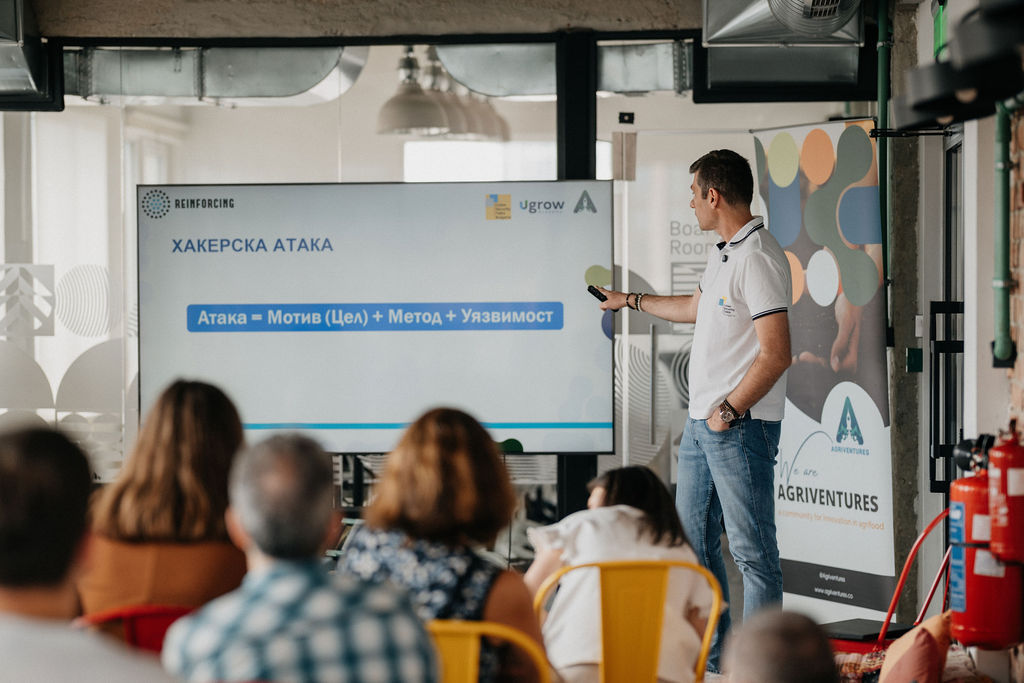
A: Pavel Georgiev from Cyber Security Talks Bulgaria gave, honestly, one of the most eye-opening talks of the day. He walked through information security fundamentals, then got specific: hacker motives, denial-of-service attacks, and malware, before turning to real cases. His business email compromise example landed hard with the room, a $20 investment and seven days of work were enough for attackers to walk away with $1.2 million in one documented case. He also showed a deepfake demonstration that made it very clear how close that threat already is to Bulgarian businesses, not a future risk but a current one. Where he was most useful was in the practical advice: checking whether your email and password have already leaked, using a password manager, starting backups today with tools like Duplicati, CobianSoft or UrBackup, and running a free check at e-security.bg/cybercheck. For an agri-food sector that's only just starting to digitize, hearing that cybersecurity has to be built in from day one, not bolted on later, was an important note to end on.
Q: What's next for you?
A: I'll be supporting four missions across Europe, drawing on my network and on what we've built at Agriventures.co, to connect farmers and innovators directly with these opportunities. Pre-registration is open now for anyone interested, at projects.agriventures.co/missions.

The role of Agriventures in supporting agrifood innovation
As the agritech startup ecosystem grows across Europe, initiatives such as Agriventures are helping connect entrepreneurs, researchers, investors, and policymakers working in agriculture and food innovation.
Agriventures focuses on supporting agrifood startups, biotechnology innovation, and access to European funding for agriculture, while also helping entrepreneurs navigate the complex landscape of startup financing, venture capital, and research commercialization.
By strengthening connections between startups, research institutions, investors, and farmers, Agriventures contributes to building a stronger agricultural innovation ecosystem that can accelerate the transition toward sustainable agriculture and resilient food systems.
Through knowledge sharing, events, and ecosystem building, Agriventures helps ensure that promising agritech innovations can scale and reach farmers, food producers, and global markets.
Tags
Related Articles
Continue reading our latest insights and updates from the AgriVentures ecosystem.

Funding the Future of Food
A Guide to Agrifood Startup Financing in Europe (2026) Europe's agrifood sector is under pressure from every direction: climate volatility, labor shortages, tightening environmental regulation, and a food system still responsible for roughly a third of global emissions. That pressure has turned into one of the most active funding corridors on the continent. Between EU-level research grants, national innovation agencies, dedicated agrifood venture funds, and a growing bench of sector-specific...

Our Member UHT Breaks Ground on €11.8 Million Center of Competence for Agri-Food Systems and Bioeconomy
A symbolic groundbreaking ceremony for the Center of Competence "Agri-Food Systems and Bioeconomy" took place in the courtyard of the University of Food Technologies (UHT) — and we're proud that UHT is one of Agriventures' members. The project is funded under the "Scientific Research, Innovation and Digitalization for Smart Transformation" Programme 2021–2027, with a total budget exceeding €11.8 million. The new center will create modern scientific infrastructure designed to meet the...

Sofia Is Calling: Why Agriventures Connect 3.0 Is the Stage International Agri-Food Innovators Can't Afford to Miss
20 April 2027 | Sofia, Bulgaria Central and Eastern Europe has quietly become one of the most interesting growth stories in agriculture, food, and technology - and on 20 April 2027, that story gets its biggest stage yet. Agriventures Connect 3.0 opens in Sofia, and early access is now live for sponsors, speakers, and partners who want in before the room fills up. A Track Record Worth Building On Connect 2.0 wasn't a pilot - it was proof. Over 200 participants from 15 countries filled the room...

Introducing Agriventures Projects: A new home for our Innovation portfolio
We're excited to announce the launch of AgriVentures Projects - a dedicated space where you can follow the EU-funded initiatives, partnerships, and field pilots that AgriVentures is driving across the agrifood sector. Until now, our work on individual projects lived scattered across updates and case studies. Projects brings it all together in one portfolio, so startups, farmers, researchers, and partners can see exactly how AgriVentures turns funding into real-world impact. What you'll find...

SAFE-AGRI Workshop Brings Together Stakeholders to Shape Responsible Innovation in the Agri-Food Sector
Co-creation Workshop: "Security and Innovation in Agri-Food Technologies: Digitalisation, Automation, Data Management and Security Assessment" Following the successful launch of the SAFE-AGRI project, Agriventures has taken another important step towards advancing responsible innovation in the agri-food sector by delivering its first stakeholder co-creation workshop on July 6. The event brought together more than 15 participants representing academia, research organisations, technology...

Agriventures member spotlight: The Good Club achieves a major milestone with its ESG impact reporting methodology
We are proud to celebrate an important achievement by our member The Good Club, which has successfully validated the methodology behind its ESG Impact Reporting through an independent assessment by Bureau Veritas. This milestone marks an important step in transforming an innovative concept into a trusted solution that businesses can confidently adopt. From Innovation to Market-Ready Solution Building a new product requires more than a great idea. It takes continuous testing, validation,...
Never Miss an Update
Join our community to receive the latest insights, funding opportunities, and industry news from AgriVentures.